 English
 Español
 Português

Imagine you're selling software to a small business. You've had a pretty good conversation with the owner and explained what your product does. You're just getting to the price when they say something you weren't expecting.
"We already have software that does most of this."
Ah. That's annoying.
You explain how your product is different and perhaps mention a couple of features the competitor doesn't have. Then you try to steer the conversation back towards why they should consider switching. The customer listens politely, says they'll think about it, and you both know they probably won't.
Afterwards, you replay that moment in your head. You should have asked what they were using. You should have explained the differences more clearly. Perhaps there's a better way to handle that particular objection. So you make a mental note to practise it before the next call.
But consider something. The customer already had that software when you started the conversation.
They weren't keeping it a secret. Five minutes earlier you could have asked what they currently use, what they like about it and whether there's anything they'd change. You might have discovered that they're perfectly happy with their current system. In that case you've saved both of you ten minutes. Or perhaps there was a real frustration you could have explored before explaining how your product might help.
Instead, you spent ten minutes selling something without knowing whether they needed it.
I wonder how many of the objections we practise handling are really questions we should have asked earlier.
The skills we struggle with
We've analysed more than 900,000 sales calls across different organisations and industries. We score behaviours such as tone of voice, discovery, objection handling and closing.
Discovery keeps coming out as one of the weakest areas.
In our scoring system, a score below 40 means a very weak example of a behaviour. About four in ten discovery scores fall into that group. That compares with roughly one in four for objection handling and one in three for closing. Tone of voice, meanwhile, scores below 40 on only about one call in seventy.
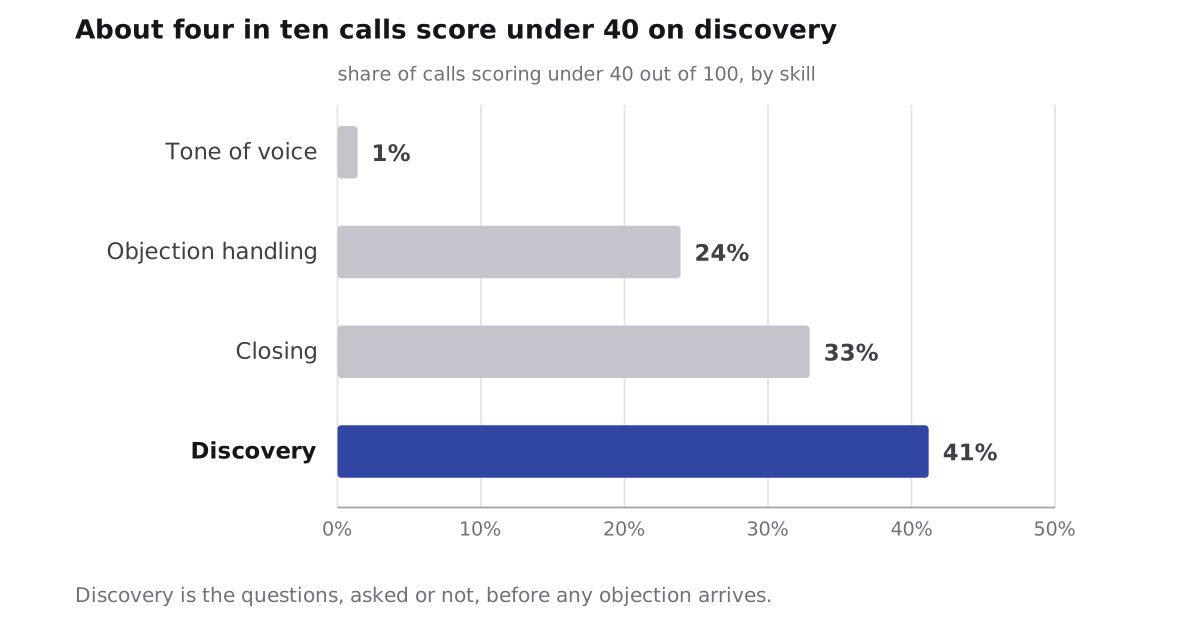
Now, these aren't four identical tests. Different organisations define different behaviours. Some scoring rubrics may be stricter than others. I wouldn't conclude from this alone that salespeople are truly worse at discovery than objection handling.
But the pattern is very consistent. Discovery scores below tone of voice in every company where we could compare them, sometimes by a wide margin. And removing the few discovery scores of zero doesn't change the overall picture.
We've written about this difference before. But I think there's a more interesting point here than telling salespeople to improve their discovery skills.
Poor discovery may be creating some of the objections we're training people to handle.
The objection was there all along
Think about some of the objections that often come up in sales conversations.
"We don't have the budget."
"We're happy with our current provider."
"I need to discuss this with my partner."
"Maybe next quarter."
Those are all perfectly fair reasons not to buy something. And they're all things you could have discovered before spending fifteen minutes explaining your product.
Of course, knowing about an objection doesn't always make it go away. If the customer really has no budget, asking about it earlier won't magically create one. But it changes the conversation a lot.
Suppose you discover in the first few minutes that the customer already has a competing product. You can ask what they like about it, what they don't, and why they're even looking at other options. Perhaps there's an opportunity. Perhaps there isn't.
Now compare that with discovering the same information after you've finished your pitch. The customer has already spent ten minutes listening to features they may not need. And you're suddenly trying to convince them that the product they already own isn't good enough.
Same customer, same objection, very different conversation.
I suspect this is one reason objection-handling training can become a bit of a trap. We teach people how to respond when customers push back, which is useful. But it can also lead them to think of objections as one-off events. Something happens, you use the right technique, and hopefully the customer changes their mind.
Sometimes that's exactly what's needed. But sometimes the objection is the customer telling you something you should have known before you started selling.
What I'd practise instead
If I were coaching someone who often struggles with objections, I'd still want them to know how to handle the common ones. But before spending another hour rehearsing rebuttals, I'd listen to the first few minutes of their calls.
Are they finding out what the customer currently uses? Why they're considering a change? Who makes the decision? Whether there's a budget or a deadline? Or are they asking one or two polite questions before launching into the pitch they've practised a hundred times?
Then I'd take a few calls where objections came up and work backwards. Was there something the rep could reasonably have discovered earlier? If so, what question would have brought it out?
That's probably a more useful exercise than writing another script for "we already have a provider".
And it might help with closing too. Our closing scores are also much weaker than objection handling. That suggests getting through the hard part of a conversation doesn't always mean people are good at finishing it. A rep can handle every objection beautifully and still fail to find out whether the customer actually wants to buy.
There's a lot of sales training about what to say when the customer resists. I wonder whether we'd get further by spending a little more time on what to ask while they're still happy to talk.
Because by the time someone says "we already use something", the chance to discover that casually has passed. You're now trying to recover information you could have had ten minutes ago.
And that's a much harder conversation.
CallCoach scores every call, the first five minutes included. Try it on your own calls and see how many of last month's objections were questions you could have asked earlier.
All CallCoach data in this post is aggregated, anonymised performance data from hundreds of thousands of calls across a variety of industries. We report the trends we spot; full statistical analysis is beyond the scope of a blog post. The link between discovery and objections discussed here is a hypothesis based on the scoring patterns. We haven't shown that one causes the other.