 English
 Español
 Português
You have made thousands of sales calls. You can probably describe five of them.
There's the one where everything clicked and the customer signed before you had to ask twice. There's the shocker where you got the name wrong in the first ten seconds and never recovered. And there's probably a forty-minute one that felt like a proper conversation, where you understood the customer, they understood you, and you came away thinking: that's what a good sales call feels like.
The problem is that none of us remembers a representative sample of anything. We remember the unusually good bits, the painful bits and the stories we've told often enough that they've become part of how we think about ourselves.
We've now analysed close to 900,000 sales calls, containing more than three million scored sales behaviours. Most of them are thoroughly unmemorable, which is precisely what makes the pile useful. Put all those ordinary calls next to the handful a salesperson remembers and some fairly plausible beliefs start looking a bit shaky.
"My best calls show what I'm capable of"
They do, technically. They're just not particularly useful for understanding how you normally sell.
In one week we looked at, about three quarters of reps had at least one call among the top 10% in their organisation. Their best call averaged about 14 points above their own typical call.
That's a huge gap. And it means the ability to produce a great call isn't particularly rare. Give enough salespeople enough conversations and most of them eventually have one where everything lines up.
We've seen the same thing at a larger scale. Reps who spend most of their time near the bottom of their team still have good weeks. A little under half of the reps we found in the bottom quarter had at least one top-half week during the following three months. Most still ended up near the bottom.
So yes, your best call shows what you're capable of. The more useful question is how often you can do it.
That's why the best call of the week is a poor place to coach from. The call you remember because you were brilliant may be the least representative call you made.
"At least I'm good with people"
I suspect this is the nicest thing you can tell a salesperson, partly because it's probably true.
Tone of voice is comfortably the highest-scoring of the sales skills we measure. Needs analysis and closing sit considerably lower. Across the organisations where we can compare them properly, that ordering is remarkably consistent.
Which creates an odd problem with one of the most common bits of sales feedback. You're great with customers. You build rapport. You sound natural on the phone.
Good. So does almost everyone else.
That doesn't make tone unimportant. Sound impatient or disinterested and you can ruin a call very quickly. But once you're reasonably good at it, being pleasant to talk to doesn't separate you very much from the people sitting around you.
The bigger differences show up later: what questions you ask, what you do with the answers, how you handle resistance and whether you actually ask for the business.
I think that's why "good with people" can become a slightly dangerous piece of feedback. It's easy to hear, easy to compliment and feels fundamental to being good at sales. Meanwhile the less visible skills may be the ones with considerably more room to improve.
"That was a great call. We talked for 40 minutes."
This one is particularly seductive because long calls feel earned. You got them talking. You built rapport. They told you about their business. Meanwhile somebody else on the team keeps getting off the phone after four minutes.
We measure lead quality from the opening minute of the conversation, before we know how long the call will last. When we sort those calls by duration afterwards, the relationship is enormous.
Calls that end inside two minutes start with lead quality around 3.4 out of 10. Once conversations run beyond twenty minutes, it's above 6.
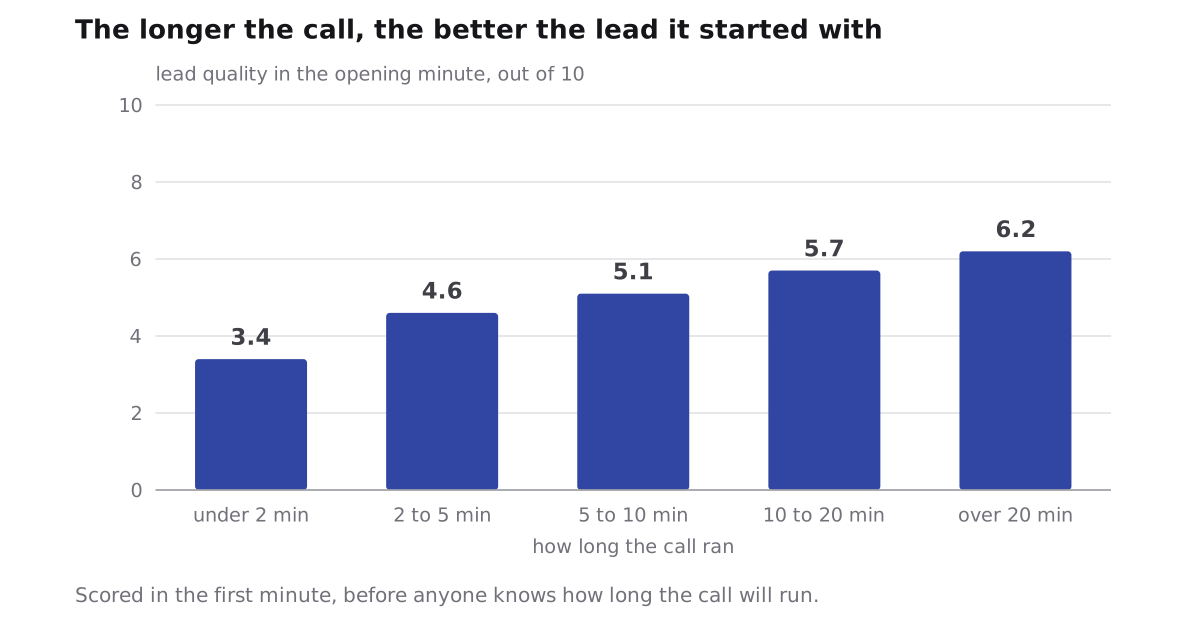
In other words, good leads talk longer.
That doesn't mean skill has nothing to do with call duration. A good salesperson can presumably keep the right person engaged and a terrible one can certainly end a promising conversation early. But the customer brought a lot more to your forty-minute masterpiece than your memory is likely to give them credit for.
Sometimes they just really wanted to talk to you.
"I'm just not a closer"
Closing feels personal. Some people seem to have a knack for knowing when to ask, how hard to push and what to say when the customer hesitates. If you're not one of them, it's quite easy to conclude that you're simply not very good at closing.
Then we looked at teams.
If closing mostly belonged to the salesperson, you'd expect good and bad closers to be scattered around the company. Some teams would come out a little better than others because that's what averages do, but knowing which team someone worked in shouldn't tell you very much.
It tells you quite a lot.
In some companies we looked at, the best team on closing was so far ahead of the worst that a fairly ordinary rep in one could comfortably outperform a strong rep in the other. And these weren't teams having a lucky month. The teams that scored well early in the data were, with very few exceptions, still the ones scoring well much later.
We don't see anything like the same effect with tone of voice. People who sound good on the phone are scattered much more evenly between teams. Closing, for whatever reason, clusters.
We can't see why from our anonymised data. It could be the manager. It could be different leads, products or queues. It could even be that the company deliberately put its strongest closers together. But if you think you're a poor closer and most of the people sitting around you look remarkably similar, I'd investigate that before making it part of your identity.
You may still need to get better at closing. I'd just be careful about deciding how much of the problem is yours.
"I know when I'm getting better"
The reverse is more fun. You try something new, have a brilliant week and think: finally, that worked.
Sometimes it did. Sometimes you just had a brilliant week.
We followed reps after unusually large jumps in their weekly scores and found that a substantial part of the improvement disappeared almost immediately. After that first week, though, very little changed. The improvement that survived tended to still be there a month later.
Bad weeks behaved almost exactly the same way.
I love the symmetry of that because we're not remotely symmetrical about it ourselves. If I have a terrible week, I'm perfectly capable of producing a detailed list of external factors that explain why it wasn't really me. If I have a fantastic week immediately after changing something, the causal analysis tends to be considerably shorter.
The data is less easily impressed. Give both a week.
If the improvement disappears, enjoy the good week but don't build a training programme around it. If it's still there the following week, that's when I'd start wondering what changed and whether you can keep doing it.
Which brings us back to those five calls you can remember.
They're not useless. The great call really did happen. You really did keep someone talking for forty minutes. You really have had weeks where everything seemed to work, and there may genuinely be parts of selling you're better or worse at than the people around you.
They're just a terrible sample.
Memory keeps handing you the calls with a story attached, and because you're the only person who appears in all of them, you naturally end up as the main explanation. I nailed that call. I'm good with people. I'm terrible at closing. I've finally figured this out.
Across nearly 900,000 calls, the explanations get messier. The customer matters. The week matters. The team matters. Luck matters. And yes, the salesperson matters too.
The useful bit is working out which things keep following you around.
That's difficult to do from the five calls you remember. It's considerably easier when you can see the other few thousand.
CallCoach analyses the forgettable calls too. Try it on your own calls and see whether the salesperson in the data looks like the one you remember.
All CallCoach data in this post is aggregated, anonymised performance data from hundreds of thousands of calls across a variety of industries. We report the trends we spot; full statistical analysis is beyond the scope of a blog post.